Keeping The Pride Honoring the Tradition
Keeping The Pride Honoring The Tradition
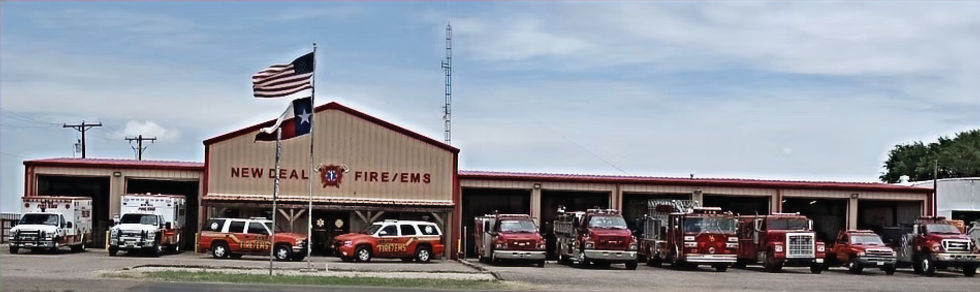
Mission Statement
The members of New Deal Fire/EMS shall strive to protect the lives and
property of the citizens of the City of New Deal and surrounding
community through fire suppression services, emergency medical
services, pre-fire planning, and public education of both fire and accident
prevention. We will serve this community to the best of our abilities and
training. We are committed to continuously improving our abilities to
protect that life and property of our residents, the community of New
Deal, surrounding communities, the County of Lubbock, and the State of
Texas.
Info
About Us
The New Deal Fire / EMS has approximately 25 volunteers. Our volunteers
receive in-house training, and attend the Lubbock Area Fire Conference, and
Texas A&M Municipal Fire Training School.
The New Deal Fire / EMS is a
member of the State Fireman's and Fire Marshal's Association and compliant
with the National Incident Management System.
In addition to Fire and EMS services that we provide, the NDVFD strives to
be a community partner with involvement in numerous activities throughout
he City of New Deal and Lubbock County.
Coverage Area
The New Deal Volunteer Fire Department, Inc. serves the New Deal community and the surrounding areas of Lubbock County. We provide fire suppression, rescue operations, and emergency medical services. We serve a 94 square mile radius area of northern Lubbock County. We are located 12 miles north of Lubbock, Texas on I-27.
History
The New Deal Volunteer Fire Department, Inc., was founded in 1977, and is a combination Fire/EMS organization. For the past 44 years, we have served the New Deal, Texas community and the surrounding areas of Lubbock County. We provide fire suppression, rescue operations, and emergency medical services. We serve a 94 square mile radius area of northern Lubbock County. We are located 12 miles north of Lubbock, Texas on I-27. The department was established in 1977, and is funded by Lubbock County, Fundraising, Donations, Hard Work, and Dedication.
Code of Ethics
Members of New Deal Fire/EMS, Shall: Strive to conduct departmental business and represent this department in a manner that shall inspire public confidence. Strive to never allow personal gain or personal profit to be derived from association with New Deal Fire/EMS. Strive to consider fellow firefighters and medical personnel by the standards we have chosen to maintain. Strive to never jeopardize the lives or safety of our fellow members. Strive to possess the knowledge to perform our job and make the most of opportunities to learn more about our duties. Strive to continually improve our professionally. Strive to avoid associations with businesses or persons whose goals are inconsistent with the goals of New Deal Fire/EMS. Strive to never make claims of qualifications we do not possess. Strive to pledge our loyalty to our community, our fellow members, and to New Deal Fire/EMS.
Department Values 10 Behaviors
Department Values (10 Behaviors)
New Deal Fire / EMS is guided by a set of ethics, values, and philosophies that comprise 10 Behaviors that inform the focus of leadership and organizational behaviors.
1) Put Community First
Be customer focused. The needs of the community come before our own. Focus on educating citizens, preventing emergencies, and when an emergency occurs mitigating its negative effects.
2) Practice Safety
Take responsibility for maintaining a safe work environment. Know your environment and promptly report hazards, accidents, and injuries. Needless injury and loss of life are unacceptable.
3) Act Inclusively
Act Inclusively – New Deal Fire / EMS is comprised of people with different personalities and life experiences. Appreciate the differences in others. Encourage coworkers to express opinions and ideas. Treat all internal and external customers with courtesy, politeness, and kindness.
4) Train until you can't get it wrong
This is the difference between an amateur and a professional. As professional emergency service providers, master the skills necessary to protect the community. Decisions affect the outcomes; Training affects those decisions.
5) Honesty (Be Truthful)
Trust is earned not given. Being truthful, even when mistakes are made, leads to trust and admiration. Honesty is the fastest way to prevent a mistake from turning into a failure.
6) Make Fact-based Decisions
It is easy to let emotions cloud judgment. Make logical decisions and use your experience and education to gather facts.
7) Integrity (Do the right thing even when no one is looking)
Integrity is the most valuable and respected quality of leadership. Simply doing the right thing can affect those we serve in a positive way. Strive to be a positive representation of the Department, City, and Fire Service.
8) Commitment (Support Organizational Goals and Objectives)
As a team, work together toward a common vision and direct individual accomplishments toward organizational objectives. This is what leads to uncommon results.
9 Lead by Example
Nothing speaks like results. To build the kind of credibility that connects with people, deliver results before delivering a message. Get out and do what you advise others to do. Communicate from experience.
10) Be Responsive and Accountable
Do it right and do it right now. Always act with a sense of urgency, with clear focus on the needs of those you serve. Perform assigned tasks to the fullest and never expect others to do your jobs. Take ownership of your actions.
Key Safety Behaviors
1
Drive Defensively
2
Drive slower rather than faster
3
Intersection: if you can’t see, STOP
4
Always wear your seat belt
5
Wear Full bunker gear or appropriate PPE
6
Don’t breath smoke or contaminated atmosphere
7
Attack with a sensible level of aggression
8
Always work under command--NO FREELANCING
9
Keep your crew intact
10
Maintain a communication link with your command
11
Always preplan and have an escape route
12
Never go beyond your air supply
13
Use a big enough and long enough hose line
14
Evaluate the hazard--know the risk you are taking
15
Follow standard fire ground and incident procedures at all times
16
Know and be part of the plan
17
Vent early and Vent often
18
Provide sufficient lights for the work area
19
If it’s heavy, get help
20
Always watch your incident area position
21
Look and listen for signs of collapse
22
Rehab fatigued firefighters and medical personnel
23
Pay attention at all times
24
Everybody takes care of everybody else
25
Always follow all infection control guidelines
26
Follow keys 1-25 and Everyone goes home!
ISO Rating
ISO (Insurance Services Office) through its PPC (Public Protection Classification) help
establish appropriate fire insurance premiums for residential and commercial properties.
Insurance companies need reliable up-to-date information about a community's fire
protection services.
ISO collects information on municipal fire-protection efforts in communities throughout the
United States. In each of those communities, ISO analyzes the relevant data using its Fire
Suppression Rating Schedule. It then assigns a Public Protection Classification from 1 to
10. Class 1 represents exemplary public protection, and Class 10 indicates that the area's
fire-suppression program doesn't meet ISO's minimum criteria. ISO develops a split
classification. The first class applies to properties withing five road miles of a fire station
and within 1,000 feet of a fire hydrant. The second class applies to properties within five
road miles of a fire station but beyond 1,000 feet of a fire hydrant.
To determine a community's Public Protection Classification, ISO conducts a field survey.
Expert ISO staff visit the community to observe and evaluate features of the fire-protection
systems. Using a manual called the Fire Suppression Rating Schedule, ISO objectively
evaluates three major areas:
1) The Fire Department
A review of the fire department accounts for 50% of the total classification. ISO
focuses on a fire departments first-alarm response and initial attack to minimize
potential loss. Here, ISO reviews such items as engine companies, ladder or service
companies, Distribution of fire stations and fire companies, equipment carried on
apparatus, ;umping capacity, reserve apparatus, department personnel, and training.
2) The Water Supply
A review of the water-supply system accounts for 40% of the total classification. ISO
reviews the water supply a community uses to determine the adequacy for
fire-suppression purposes. It also considers hydrant size, type, and installation, as
well as the inspection frequency and condition of fire hydrants.
3) Fire Alarm & Communications Systems
A review of the fire alarm system accounts for 10% of the total classification. The
review focuses on the community's facilities and support for handling and
dispatching fire alarms.
The New Deal Fire Volunteer Fire Department was inspected on June 9, 2009, as of May 1,
2010 , our classification moved from a 9 down to a Class 5. At this time you are able to
review and download our classification. Thank You for continued support